Showing posts with label 12x12 Conference. Show all posts

Monday, September 01, 2025

12x12 Conference: November PART I

How to Engage Someone Who Has Harmed You

INTRODUCTION

You must "judge" to see that the person who has hurt you, DOES have a speck. The whole pint of this teaching that begins with "Do not judge" is that Jesus calls you to judge other people -- and to judge them well. 

He is more interested in being provocative than being clear. 

When Jesus says, "do not judge or you too will be judged," he is using the word judge to a posture of condemning the other person ... and condemning another person is very different from naming their or identifying their speck. 

You need to judge accurately: 

1. Normal Garden-variety sinners

2. Wicked people

3. Evil people

You must first come to see: What kind of person am I dealing with? You will be called to engage each of these categories of people differently.

WICKED PEOPLE need to be shamed. Luke 13 "You hypocrites! Doesn't each of you on the Sabbath untie your ox or donkey from the stall and lead it out to give it water? Then should not this woman, a daughter of Abraham, whom Satan has kept bound for eighteen long years, be set free on the Sabbath day from what bound her?"

And then in Luke 13:17, "When Jesus said this, all of his opponents were humiliated." (Very similar to shame.)

Why does Jesus treat people differently? This is not how he treated the woman at the well (who has done a lot of bad things.) Why is he kind and welcoming to her and shaming to these religious leaders in Luke 13? 

He engages with a person based on the condition of that person's heart. Jesus knows if the person is wicked or just a garden-variety-sinner. 

Your calling is to be shrewd as a snake or wise as a serpent and innocent as a dove. Matthew 10:16

Most of you know that you are supposed to be as innocent as a dove? But are you aware that you are supposed to be as shrewd (showing sharp powers of judgment) as a snake or as wise as a serpent. 

What happens if you engage a wicked person the same way you talk to a normal sinner? At best, you are going to feel like you keep running into a wall. Your words will bounce off a wall and nothing changes.

"Do not throw your pearls to pigs. If you do, they may trample them under their feet and turn and tear you to pieces." Matthew 7.

Some of you are being torn to pieces by people in your life who do not mean you well.  People are taking the pearl you offer and tearing you to pieces. You say, "Ouch, that hurt." And the person just tears you to pieces. They don't deserve your pearls. 

So you must identify: what kind of person are you dealing with? The woman at the well? Or a hypocrite religious leader? How are you supposed to know?

Remember: You can never judge another person with finality. There is no person whose heart is beyond  redemption. 

The purpose of today is NOT so you can go out into the world, start pointing at people and saying, "She's wicked, he's a normal sinner, and that person over there is evil." You want to know who you dealing with or you will hit your head against a wall over and over and over again. 

HOW DO WE IDENTIFY WICKED PEOPLE?

You may do wicked things but not be a wicked man. Have you repented? And do you have a pattern of scapegoating people? There has to be a persistent pattern of wickedness before you say to yourself, "Okay, my dad is wicked."

In Jeremiah 8:6 God judges Israel by saying, "No one repents of his wickedness, saying 'What have I done?'"

The essence of wickedness is the refusal to look honestly at your own words and actions and say, "What have I done?"

Wicked people refuse to suffer the guilt feeling of guilt.

Wicked people flee the light of self-exposure and the voice of their own consciousness. Wicked people will not bear the voice of their own conscience. They have hardened their hearts and consciences. They have silenced it. 

Wickedness is not about the magnitude of the harm you do. It is the refusal to acknowledge the harm.

If they can feel the harm that they have done and can acknowledge it they are not wicked. They must also actually FEEL that harm. 

"The central defense of wicked people is not their sin but the refusal to acknowledge it. Wicked people are characterized by their absolute refusal to tolerate the sense of their own sinfulness. " Scott Peck, PEOPLE OF THE LIE.

You may be the best community member ever and ONLY harm your three children. If they are not repenting, they are more than a garden-variety sinner. They have hardened their conscience and can't feel what they have done. 

They won't claim to be without sin. They aren't stupid. They will often admit (especially if they are a Christian) to being a sinner. But they won't be able to tolerate a sense of their own sinfulness on their heart. "Oh my gosh, what have I done to my three daughters. What have I done?" They won't feel genuine sorrow and remorse.

Since wicked people can't bear to have their sin brought into the light, they are impervious to feedback that doesn't feel good. Your words of hurt do not land. Your "ouch" does not affect them. 

If you say to a wicked woman, "I was hurt when did X," she will not feel compassion for your hurt. She will not feel sorrow that you are hurt. They will deny intentionality. They will say, "I didn't mean to hurt you."

Wicked people are unwilling to compassionately empathize with the pain of anyone who says, "Ouch, you hurt me!"

Psalm 17, "They close up their callous hearts, and their mouths speak with arrogance."  The wicked have made a thousand choices over many years to slowly but surely harden their hearts. And so their heart is calloused. 

YOU WILL NEVER FEEL THAT THEY ARE HURT THAT THEY HURT YOU! THEY CAN SAY, "I AM SORRY," but the words are empty.

1. SCAPEGOATING

Scapegoating is about projecting your own sin and failure onto another person and then punishing that other person for it. The goal of all scapegoating is to separate the scapegoated person from the family, from the church, from the business, from the community ...

They will accuse you of the very things they do themselves. It isn't random. So a son says to his father, "Dad, growing up, you ever wanted to be with me or spend time with me." The son is saying, "OUCH!" And their father, "I'm sorry you feel that way, but it felt like you never wanted to be with us. You always kept your mother and I at arms-length." That is scapegoating.

When you accuse a wicked person, a wicked person will accuse you back. A wicked person does not listen to rebuke.

A daughter says to her mom, "You leaned on me too much when I was a kid." And then the mother says, "Well you wanted the burden. You told me you wanted us to be close and wanted to discuss things."

Another example. Daughter says, "Can we talk about some of the ways that you hurt me when I was growing up." She is just asking for a conversation. The mom says, "Oh sure, what horrible thing did I do know?"

Scapegoating is the beginning of being cast out of a family.

Psalm 38:20 "Those who render me evil for good accuse me because I follow after good."

"Prophets and priests alike, all practice deceit. They dress the wound of my people as though it were not serious. 'Peace, Peace,' they say, when there is no peace. Are they ashamed of their loathsome conduct? No, they have no shame at all." Jeremiah 6.

Dan Allender say, "We all fear to some degree being cast out of another garden -- be it a tightly knit family or an authoritarian church -- yet to defy a wicked person results in sure banishment." It's a huge fear of us as humans to be cast out. And if we defy a wicked person, they will begin the process of banishing you from the family.

2. INTELLECTUAL DEVIOUSNESS

This is the second characteristic of wicked people. "His speech is smooth as butter, yet war is in his heart; his words are more soothing than oil, yet they are drawn swords." Psalm 55:21

The Bible is full of language about being spun around by the words of wicked people. Psalm 64: 3 says: "They sharpen their tongues like swords and aim their words like deadly arrows."

Psalms 109:2 says, "Wicked and deceitful men have opened their mouths against me; they have spoken against me with lying tongues."

Are you beginning to get a feel in your body for what it is like to talk to a wicked person about how they have hurt you? You may enter the conversation feeling clear in your heart about what you want to say. But as the convo unfolds, you start to feel confused. You will often feel confused during and after the conversation.

"Wicked people routinely portray their motives and behavior as innocent. They are never the perpetrator of harm, but always the victim of it. They are very gifted in making the victim of their abuse feel like the perpetrator of it. If you expose the darkness of their behavior, you will be accused of being troubled, unreasonable, too sensitive or even cruel: 'How could you think that about me?'

A wicked man will portray himself as the real victim -- you simply misunderstand his intentions and then falsely accuse him. Because wicked people see themselves as the real victims, they feel justified in making you pay for what you have done to them." -- Allender and Longman

The result of the spinning and shifting, you'll often come away wondering if you are the one with the problem. A lot of self-doubt. The wicked are brilliant from diverting attention away from the issue you raised and highlighting the problem with you.

3. WEAPONINIZING FRAGILITY

They use their tears as a weapon to keep you from speaking. #1 and #2 are when people use power against you. This one is power that operates under a disguise of powerlessness or weakness. 

Are they pretending to be not smart or not strong enough? Weaponizing her fragility is a very powerful and sophisticated move. You think of her as weak, but she is actually far more powerful than you realize. Just the possibility of her tears keeps you, a grown man or woman, keeps you from speaking a sentence to her. And you aren't a timid person. You'll risk saying hard things to others -- but not your mom. 

This isn't true of all wicked people. But it is common. Wicked people are essentially cowards. Wicked people despise the cost of growth. The cost of growth is repentance. You have to own your sins and failures and take ownership of them. 

Hopefully, you see, it is not always easy to spot a wicked person. The temptation is to think, "If I saw a wicked person I'd know it."

"The wicked are most ordinary. They live down the street. They may be rich or poor educated or uneducated. There is little that is dramatic about them. They are not designated criminals. More often than not they will be 'solid citizens' -- Sunday school teachers, policeman, or bankers, and active in the PTA." -- Scott Peck, People of the Lie

Wicked people do not stand out as bad people. They can be incredibly kind and compassionate. They can be up front on stage at church and sing worship songs with uplifted hands. In fact, it is likely that a wicked person will treat you with kindness and compassion as long as you don't threaten their self-image by confronting them about something. 

2 Corinthians 11: "Such people are false apostles, deceitful workers, masquerading as apostles of Christ. And no wonder, for Satan himself masquerades as an angel of light. It is not surprising, then, if his servants also masquerade as servants of righteousness." 

EVIL PEOPLE

Evil people add a commitment to destroy you and humiliate you. Wicked people won't seek to destroy you as long as you play the game the way they ask. Evil people also want to humiliate you and eventually destroy you. They will use mockery geared to your humiliation. You will know the feeling in your body of being humiliated.

HOW TO LOVE PEOPLE WELL

If your relationship with, a parent for example, hasn't changed in the last five years, you haven't loved the person well. Love always, always disrupts the status quo. Love disrupts the current state of the relationship. 

Honor Your Father and Mother:

#1 -- Much of what you think of as honoring your parents may not be honoring at all.

#2 -- Much of what you think of as dishonoring your parents may actually be the beginning of a heart to do them good.

Often times the desire to speak truth to your parents comes from a longing for a deeper, more honor relationship with them. 

Part of you is actually wanting more goodness with your parents. More closeness. More authentic, genuine, real relationship.

Are you able to take a risk with someone and say, "Can we talk about the ways you harmed me growing up."

HOW DO YOU LOVE A WICKED PERSON?

Direct confrontation will not work with a wicked person.

You can offer a pearl and see what they do with it. Telling someone else how you've experienced them and see what they do with it. Give the boss that hurt you a pearl and see what they do. If their response indicates that there is no curiosity about how he harmed you, then you are most likely dealing with a wicked man with a hardened heart. 

"The key to loving a wicked person is judicious, well-planned disruption. The key is insightful preparation, clear boundaries, and courageous consequences." Dan Allender

INSIGHTFUL PREPARATION

You have to tailor your words to the kind of person you are dealing with.

"An enormously good gift to give a wicked person is to foil their effort to win, to frustrate their attempts to dominate. Wickedness can never be overthrown through rational, reasonable argumentation." Dan Allender

You can't engage with a wicked person the way you would with a regular garden-variety-sinner.

Asking questions that disrupt the status-quo. 

The goal is to expose and invite. 

"Sometimes what is called for is a cunning strategy in which you outmaneuver the enemy for the purpose of rendering her powerless so that you can offer her opportunity for restoration." Dan Allender

Where are you editing what you really want to say deep down. Status quo = bondage.

Some of you can't even broach the subject. Way too scary and painful to even contemplating doing it. There is something overwhelming about saying a sentence or two like that.

Those words are a pearl that you are offering her. You can see how she responds.

Your task is not to tell them what they did wrong. It is to tell them how you have experienced them and are experiencing them. 

When you are committed inside to convincing another person how they have harmed you, you have become connected to them in an unhealthy way. You shouldn't NEED that the other person to acknowledge it for it to be real.

DO NOT TRY TO CONVINCE OR COMPARE. IT IS TO OFFER A PEARL.

If the wicked person continues to make comments that are inappropriate and they won't stop doing it, you may have to offer CLEAR BOUNDARIES and COURAGEOUS CONSEQUENCES. You say, "I'm sorry, you keep saying this thing about me that I have asked you not to say. If you do it again, we will have to have a consequence." 

"At some point it i snot loving to continue a relationship with a person who consistently and perniciously sins against you without some sign of repentance and change." -- Dan Allender

A wicked person will not repent until they feel pain. So what is the consequence you are putting into place? 

In Hosea, God turns from his people. They won't admit how they have harmed God. Their hearts have hardened and they feel shame. Severing

 a relationship for a season can be a very holy and loving God-like thing to do. But he also speaks about this in the New Testament too.

"Do you think I came to bring peace on Earth? No, I tell you, but division. From now on there will be five in one family divided against each other, three against two and two against three. They will be divided ..." Luke 12

Do you have an imagination for what reconciliation could look like?

Here's the bind: 

1. The first extreme we have to resist is the temptation to judge too freely, labeling others with condescending confidence.
2. The second extreme that we have to resist is a refusal to assess data simply because we might be wrong. 

RECONCILIATION
Reconciliation requires that the offending party does three things:
1. HEAD: First, they have to fully acknowledge the harm without making excuses or blame-shifting.
2. HEART: Second, they need to FEEL sorrow and remorse over what they have done. And they need to express that sorrow and remorse to you.
3. HANDS: Third, they have to seek to rectify the harm that was done. 

And remember, there is never 100% clarity on knowing what we say is right. The life of faith is lived in uncertainty. You are never going to have exact clarity. The Bible isn't that kind of manual. 

"Forgiveness = hungering for restoration, revoking revenge, pursuing goodness." Dan Allender

Saturday, July 12, 2025

The Marriage Conference: How to Understand What's Happening in Your Marriage #6

 Rupture and Repair: The greatest longing of your partner's heart and how to get there 

Adam Young

Tune in later for notes on this one :)

The Marriage Conference: How to Understand What's Happening in Your Marriage #5

 Decriminalizing Action Tendencies

Adam Young

In the dance of our marriage, we tend to either be the Pursuer or the Withdrawer. These tendencies to either pursue or withdraw are called action tendencies. The action tendencies that each of you do need to be decriminalized. Your task is to get a PhD in your spouse's wounding. 

Your partner gets mad because YOU are the most important person in the world to them.  When your partner withdraws, you must remind yourself that they are acting with FEAR. They are afraid. 

If my partner is afraid, why don't they just stop yelling at me? Well, because of their wounds. And your brain is wounded very differently than your spouse's wounds. We have to an inflow of compassionate understanding for why we do what we do and why your spouse does what they do.  

How do you dance differently?  

1. Bless your neediness. You have to understand compassionately why you feel needy the way that you do. You name is as good, reasonable, understandable, even holy. 

2. Bless your partner's attachment style and action tendencies, as well as your own. Call it good. Even if it has negative consequences for relationships, it is very good that it developed because it allowed you to neurobiologically make it. 

3. Risk sharing primary emotion. You have to bless your neediness. How would your life look different if you stopped hating how needy you are. What if you called it GOOD the way you need your partner emotionally. Most of us believe that a "healthy adult" is not supposed to need emotional connection and soothing from your spouse. And even if you don't cognitively agree with that, it is the sense inside of like "I shouldn't need this much from him. I should be more independent. I should be more self-reliant." Can you turn to your spouse and say, "I really need you to hold me right now? I really need you to comfort me right now?" Many feel they can't do that because you shouldn't need that. Are you still at war with the way God made you? Sometimes we need another person to regulate you and soothe you. If we hate our own frailty, then we can't reach out to our partner and let them know what we need. 

If you are an avoidantly attached withdrawer, do you understand why your spouse gets frustrated/angry and can you bless why they do that? What would it look like if you validated your spouse's anger. "I know your anger tells me something important here that you need me to know." Just a version of that to your partner will help regulate them. That is ATTUNEMENT. 

For the spouse of an avoider: do you understand what it is like for your partner when there is a conflict? They probably have no idea what they are feeling because no one ever cared what they felt. This will change the dynamic of the interaction. "You probably want to leave the room right now because I'm so big and amped up. That would make sense to me if you want to leave." You must risk reaching. "Anytime we finally talk it's because I reached out and brought something out." That is packaged longing within an anger sandwich.  

As you leave here, I hope your goal is not, "I want to be a better spouse." Rather, I hope the goal is: "I want to repair more often." 

The Marriage Conference: How to Understand What's Happening in Your Marriage #4

 Owning Your Story: Navigating our Attachment Wounds (middle age)

Pascale Wright 

"Along with our ability to feel our own pain go our best hopes for healing, dignity, and love. What seems non-adaptive and self-harming in the present was, at some point in our lives, an adaptation to help us endure what we then had to go through." -- Gabor Mate, In the Realm of Hungry Ghosts: Close Encounters with Addiction 

Let's talk about mid-life and marriage right now. Kids are gone. Now what? The connection they desire feels insufficient to calm them. If we are not connected to our primary emotions, what we will do is we will demand that our wives soothe our secondary emotions. And that becomes overwhelming to your partner. Because what they begin to sus out in mid-life is something greater is going on

1. The places where attunement and attachment got us is good. We needed to enter marriage and have a re-do of sorts. We needed to be cared for in the hands of our partner. The younger self needed something of that to help us grow. But there is something in you that needs to be soothed yourself before you can reattach from your partner. Somewhere in mid-life, we have to connect with our vulnerability and ourself apart from our partner's soothing on our own. Yes with our partner by our side but primarily with ourselves. 

To be continued ....  


The Marriage Conference: How to Understand What's Happening in Your Marriage #3

How attachment styles play out in your marriage

One reason that you are having so much trouble in your marriage is because of how important you are to each other. Most of the dance moves you and your spouse make are variations on the theme of "Pursue/Withdraw." Anxiously attached people tend to do more of the pursuing.  Ambivalently attached people tend to do more of the withdrawing. Let's look at an exchange: 

Alex: "I was hurt by what you said last night." 

Bethany: "Okay." (Getting quiet, with an expressionless look on her face. She's withdrawing.)

Alex: "Do you have anything to say about how hurtful your words were? Did you even hear what I just said?" 

Bethany: (Turns her head slightly down toward the floor.) "Yes, I heard you."  

Some notes: 

Bethany is responding to his facial expression and tone of voice FIRST.  And if in phone or via text, you are imagining it even more. You respond to tone of voice in 1/10 of a second. You aren't even hearing words yet. She is afraid. Does she know she is afraid? No, because the portions of her brain that say "you are afraid right now," have not yet come online. She's avoidantly attached so she goes to her typical response which is to withdraw.

Is Bethany really unmoved? No. But on the outside it looks like she is unmoved. Her inside experience is "I'm on high alert, and I'm working very hard to get smaller so this is not worse." She is hyper-aroused, but she is withdrawing so she doesn't make it worse. So why is her face without expression? Because her nervous system is freaking out. The way her brain has learned to respond to hyperarousal is by withdrawing. She knows if she says anything, the conflict is going to get worse. Alex is already upset. So she has to not make anything worse. 

Ultimately, Bethany's amygdalia is afraid that Alex will leave. That's what her amygdalia's job is to do. You may think that they aren't afraid of that. But they are afraid of that! They have experiences of disconnection when they needed someone. Your partner's amygdalia is on the lookout for relational disconnection or abandonment. 

We are attachment creatures thru-and-thru. The deepest need we have is to know that the person we are married to is going to be there for me when I need them. Your left brain may say that you are afraid of that. But your right brain is afraid of that. 

Bethany looks like she is shut-down but she is going nuts inside. They are responding this way because you are super important to them. 

The way your spouse responds to you may not be because they are indifferent.

The pursuer often feels to their partner like they are an attacker. 

Secondary emotions like anger are an attempt to cope with the primary emotion.  

The emotional part of your brain comes online before the thinking part of your brain. 

We keep fighting about the same thing over and over again because we aren't really getting at the primary emotion of fear, sorrow, alone. We are dealing in the secondary emotion. Why. not? Why don't we just say THIS IS WHAT I AM FEELING. Because ... feeling primary emotions like fear connects you to very young and wounded parts of yourself. 

1. DYSREGULATION caused by connecting to parts of yourself that are very young and very wounded.

2. MISINTERPRETING what's going on inside your spouse. Misinterpreting their response to you. 

3. REFUSING TO SHARE PRIMARY EMOTION -- i.e. not eltting yoru partner know what is actually happening internally.

The greatest gift a man can give his wife is SELF-AWARENESS. More self-aware and less defensive especially as we reach mid-life. Women spend the bulk of their years attuning and raising their children. We've done so much work to attune and be responsive to our children. And we get to mid-life and there is a gap with a lot of men where that same growth point hasn't been reached yet. For most men, this ability has atrophied. 

The single greatest gift for your marriage is SELF-AWARENESS. You can't have a candid discussion with another person if they aren't candid and vulnerable with you.  

The Marriage Conference: How to Understand What's Happening in Your Marriage #2

 Attachment: the Foundation for Romantic Relationships

Adam Young

You are relational at your very core. Marriage is the adult relationship. It is about the emotional connection. It is about the perception that your partner is not there for you emotionally. Most marital fights are protests over emotional disconnection. 

 Underneath the content of the fight, you are asking your spouse: Can I count on you? Are you there for me? Do I matter to you? 

[Book suggestion: Hold me tight]

The strength of emotional connection: 

1. Your spouse's attunement to your needs and desires.  

2. Their responsiveness to your needs and desires.

3. Their engagement to your needs and desires. 

We have an innate need to be seen, taken seriously, and responded to. Do you feel like your spouse sees you? Do you feel that they knows about your needs and desires and wants to respond to them? 

If they aren't available, you are going to feel aloneness and helplessness. The AMYGDALIA fires when emotional connection with your partner is lost. 

Why do marriages fail? It is NOT because of conflict. It is because of decreasing emotional responsiveness.  

Attachment is a BIG Deal in marriages: 

1. Avoidant Attachment: When your caregiver is often unavailable, dismissive, or rejecting of you. You were forced to calm yourself and regulate your own emotions despite being unable to do it. The child's needs are frequently not met and communicating their needs will have no effect on caregiver. This is terrible for a child. Children need interactive regulation. They need comfort. Child becomes deeply self-reliant. They don't need anyone. Others aren't available. This child does not avoid closeness. It is not a menu item for them. There is no one there for them. "If I don't ask for help, they can't reject me. If I don't ask for help, it will go better." Since his needs and wants rarely seem to need, he soon stops even expressing his needs and wants. So, in marriage ...

1. More comfortable with emotional distance than connectedness. 

2. Their bodies have been trained to not need a human to regulate them. 

3. They tend to feel needed but not wanted. True mutuality is foreign to them.  

2. Anxious Attachment: A child will develop this attachment when caregiver is inconsistent or intrusive. Caregiver may or may not be available. Sometimes mom is there. But often they are to into their own issues. Never knowing what to expect, this girl develops a sense of anxiety, uncertainty, about whether she can depend upon mom or not. This develops an uncertainty of all other people being safe for me. For a child, inconsistency is absolute terror because children are utterly dependent upon their caregivers. 

1. She is a 40-year-old woman who experiences franticness when there is relational distress.  

2. And then they have great difficulty regulating that franticness and anxiety. 

3. They believe that unless they dramatically express their pain, it is unlikely their partner will respond. 

4. They are plagued by a deep fear that they are going to be abandoned. 

5. They habitually ask for proof / reassurance that they are connected. 

6. Anxiously attached adults anticipate relational failure. THEY ARE ALLERGIC TO HOPE. 

7. Anxiously attached adults feel too needy. They don't deserved to be loved the way they want. 

8. They often make misapraisals of partner's feelings and intentions. 

EVERYTHING CONNECTS BACK TO YOUR FAMILY OF ORIGIN! The limbic brain registers harm more deeply than everything else. How do you know what you got? Look at the BIG 6! (And remember: parents only had/have to get it right 33% of the time to get a secure attachment.)


Where you miss those six things is where you are going to struggle with your spouse!!! Whatever is missing above creates a HUGE HOLE in them and now they are desperately looking for that from their husband. 

If you couldn't say OUCH with your parent, can you say it with your OUCH with your spouse! You need repeated experiences of repair to feel secure.   

The Marriage Conference: How to Understand What's Happening in Your Marriage #1


How the past brought us together and the present can heal it

Pascale Wright 

"All relationships begin and end in separation." -- James Hollis, The Eden Project 

We come into the world looking for someone looking for us. We are ejected from the womb and then, if we are given "good enough" connection by our parents, we can handle these minor rejections. If we grow up in a home, however, that is not "good enough" with connection, we begin a journey of protecting our vulnerability. 

Most of us emerge into adulthood making a decision a long time ago to never be vulnerable again. Before we met our partner, we decided "I will not be vulnerable again." You vow to never ask for what you need, never open up your heart fully, never trust fully, and never be totally present. 

The trouble is: that decision, the defense, is running your life today with vigilance. When you reach for your partner, you wake up thinking you are in danger and it puts a stop to it. You are scared to be hurt. 

Think about the stories in your life that set in motion this protection. Where were you meant to be seen and attuned to and it wasn't available to you? What feeling of terror did it illicit in you a long time ago that you are protecting yourself from?  Did you make a specific vow or was it not intuitive? 

It happens in micro ways! Just him missing something you need can make you react. Maybe a season in your life, you are tired and your wife is critical and you have nothing more to give and you feel inadequate. But you guard against inadequacies because part of you was cursed as a child, even in micro-ways. So you avoid this. This keeps us disconnected in not offering us the most vulnerable parts of each other. 

In your marriage and your disconnection, there are usually two terrified younger selves that inhabit the bodies of you and your partner. And they are both terrified of being hurt. And this pre-dates your marriage. This idea that there are younger selves in pain, is not a way to excuse the fact that your partner has inflicted wounds in you and that you have also done the same. 

Yes you hurt one another. But we need to go back in time! You will never stop hurting your partner. But can we offer more vulnerable parts of ourselves to withstand that rupture? 

Think of the last argument you had with your partner. You are frustrated, angry, or numb. Those are not the truest parts of you. And because of that, they are not available for connection. The truest part of you is the part that feels alone and inadequate or incompetent. Those are the parts that have the greatest ability to connect the two of you. 

1. You have to know the identify feelings that live within you. What is the bigger feeling you are protecting? You need to do the hard work of slowing down and connecting with the more vulnerable feelings inside you. And guess which ones you need to focus on? Your triggers! They point you back to what is triggered inside you.

2. There has to be a place to share this with your partner. Your partner has to know the words that trigger your defense and the stories that trigger that defense. Most of us have THREE vulnerable feelings that trigger something that takes us off-line. You don't have to locate every story and every feeling in your body. There are three. And knowing those stories is so important. They will often come up with a very guarded defense structure. STORY allows softness to be present within you. You have to know your vulnerable words that trigger your defense and offer them to your partner. Most people don't know what they are feeling at any given moment OR more importantly, these words are so vulnerable and the person doesn't feel safe bringing them. If your story is used against you, you won't want to bring vulnerable stories to your partner. 

Safety:

1. Is my partner accessible at this moment to hear this story? Can they be present at this moment? If it is not the case, then find another time. 

2. When I bring a vulnerable thing, can I trust you to respond to me emotionally? 

3. Will you stay close to me? Or will you withdraw or get big? 

Vulnerability is the capacity to be wounded. It is not the risk of being wounded. It takes a level of strength that will wound me but won't take me off my feet! This is the only method toward growth. Growth requires that you are wounded. 

We often expect our marriage partner to be what our parent wasn't. And inevitably, we will recreate what we didn't have from our parents. 

We are on an epic journey for connection. All relationships begin and end in a state of separation. We are meant to grow through that. Marriage, apart from finding your partner, is designed to develop our wholeness through vulnerability through the process of pain and repair.  

This epic journey begins with our parents, it moves to our partners, and it is meant to culminate in us connecting deeper to ourselves. Experiencing pain, moving through the pain, and being able to connect and grow into wholeness is the goal. And that is hard to unpack! 

PRIMARY EMOTION: When you are talking about sharing vulnerability with your partner, that is an invitation to share primary emotion. That means it happens first neurobiologically, but we don't even have access to it. We have access to a secondary emotion. Like anger.  

We have to know our stories of harm that are getting re-inacted in your marriage: "triggered." Do you know the stories from your growing up years where those big feelings were also at play. There is no way to tease apart the past from the present. You need to get a PhD in how your spouse is wounded. Do you know some of your partner's stories of wounding? 

Vulnerability comes from the Latin VULNERO: to wound. Growth requires at some level that we are wounded ... woah. We are all in the process of becoming whole. And we lose sight of that. Our relationship and connection to partner becomes so large. We lose sight of the idea that the journey we are on is toward healing fragmentation and becoming whole. Becoming what we were meant to be from the Garden. It requires the pain of going back into spaces where you begin to diverge from who you were meant to be and to feel the pain of those experiences in order to integrate them without them ruling your life. There is nothing like pain to be able to facilitate that. 

Thank God that we get triggered! It is meant to lead us back to the explosive parts of us that were formed in childhood. The trigger that happened isn't your partner's fault. If there wasn't something that was explosive inside of you, you can't be triggered. You have to go back to the pain from a long time ago and tolerate it and move through it. 

Although your young self lives in you, your young self has you as a guide and you are stronger than you think to be able to tolerate pain today. Can I go back and reconnect to that part and tolerate that pain? There is an order to things and we are meant to grow in that order. 

A lot of Christians are taught that to be connected to ourselves is unholy. We were created to be human -- not to be spiritual. Our Creator decided we should be human. Why don't we embrace the humanity instead of the spirituality? Not connecting to the self actually produces selfishness.  


Friday, May 02, 2025

April 12x12 #4 "The Contemplative Life"

This is part 4 of a Saturday-long Conference I attended with Adam Young and a guest speaker: RICH VILLODAS for the month of APRIL. The Conference was entitled "How to Engage God About Your Story." Session 3 was entitled: "The Contemplative Life." This talk was by Rich Villodas.

To live a contemplative life, this work will require a different pace of life. You are going to have to change the way you operate and the way you do things. Oh my goodness is that true for me! I have realized that the way I approach people, my family, my life was not working for me! Am I willing to turn on a dime and start something new. Am I willing to truly learn to be with God? 

You need a CONTEMPLATIVE SPACE. You need a MONASTERY. Rich went to an actual monastery and stayed there for six hours with only a journal. Could you sit somewhere for six hours and just "be with God"? If not, why not

Who is a contemplative? A contemplative is one who slows down to BE with God. The challenge with much of our praying is that it is often transactional. How do we hold together petition and articulate our longings for God and at the same time, not regard God as a cosmic vending machine? 

A contemplative is someone who slows down to be with God -- to withhold the beauty of God. Check out Psalm 27 for more on this! (Verse 4 is the essence of a contemplative life.)

The world BEHOLD might be the most important world in the Bible because it is about fixing our attention to the presence of God. 

What is contemplation? 
You can define this as the unburied, opening of oneself to God through silence, scripture and self-examination. The Bible is full of examples of this invitation to a CONTEMPLATIVE life. God shows up in these places of silence and solitude. Think about Moses in the burning bush. Or how he shows up to Elijah. God wasn't only in the whirlwinds or fires. He shows up as a still small voice. God shows up in the sound of sheer silence

There are a few philosophical principles that we need to ground ourselves in for this: 

1. God is Closer to us than we are to ourselves
From one man he made all nations, that they should inhabit the whole earth; and he marked out their appointed times in history and the boundaries of their lands. God did this so that they would seek him and perhaps reach out for him and find him, though he is not farm from any one of us. "For in him we live and move and have our being." (Acts 17) We are his offspring!

2. Christ's work on the Cross opens the door to accessing the presence of God
Christian contemplation or contemplative prayer is grounded in an orthodox view of original sin requiring the work of Christ in the new covenant to reconcile humanity to God. Apart from this, the human spirit cannot experience the Spirit of God." (Eph. 2:5) John Coe, Embracing Contemplation

Communion with God is not some kind of human achievement, but is always a gift from God -- a gift most profoundly seen in Christ's work on the Cross. 


3. We are invited to dwell with God.
Check out John 15 for this! Pay attention to a particular passage of scripture in John 15. Repeatedly John says "Abide in me and I in you." In John's writings, the word ABIDE shows up 63 times in John's writings! He uses ABIDE, REMAIN, STAY. 

"Contemplation usually assumes the tangible reality of God's love, our shortcomings, and the inexplicable possibility of reunion." Barbara Holmes

Growing a Contemplative Life entails: 
Our hearts are prone to wander! Contemplation is a reminder to come back to God. Contemplation has nothing to do with our personality types! Being introverted and a contemplative is not the same thing. 

To become a contemplative you need to be ready to:

1. Befriend silence
2. Normalize boredom
3. Reframe distraction 
4. Embrace the truth that prayer is not something we master, but an act that forms us. 
5. Trust that God is always waiting for you with open arms. 

A few other notes:
  • The same Bible that says "Rejoice in the Lord Always" also has a book called Lamentations. 
  • Our pace of life can be violent in not allowing us to spend time with God. The contemplative life seeks to resist the violent pace of life. 
We can do something DAILY and WEEKLY in working on a contemplative life. Rich actually told us how proud he was of us for taking a day each month to be a part of this 12x12 conference. My healing is worth this! We live in a constant/continual state of partial attention. Will you make space for healing and stop moving from one thing to another and avoiding your soul. 

He encourages us to truly find a weekly SABBATH! We are not made for the unrelenting pace of life that damages the attempt at contemplation. 

How hard is it for you to just BE WITH YOURSELF!

Are you willing to make a countercultural commitment to resist the insane pace of our cultural moment? We are not living as human being are designed to be. We are designed for wonder, curiously, play and rest. 

The byproduct of trauma is that there will be no rest for you, all your remaining days. Can you just rest and be with YOURSELF?  

I have totally changed my life after my collapse in 2024. God is different to me. My priorities are different to me. I am taking the time to be contemplative and want to strive to continue to do that. 

Sunday, April 20, 2025

April 12x12 #3 "The Psalms"


This is part 2 of a Saturday-long Conference I attended with Adam Young and a guest speaker: RICH VILLODAS for the month of APRIL. The Conference was entitled "How to Engage God About Your Story." Session 3 was entitled: "The Psalms" This talk was by Adam Young.

Why are the Psalms in the Bible? Most are the prayers of people who are at the desperate edge of their lives. They are in a place of desperation. 

“The Psalms present human persons in situations of regression, when they are most
vulnerable in hurt… most sensitized to life, driven to the extremities of life and faith.”

Walter Brueggemann 

The Psalms are the prayers of people who are fully present to the rawness of their emotions and fully present to the diversity and complexity of their emotions. Our emotions are layered and complex. 

The Psalms are a phenomenal gift of God to human beings. It is hard to know what is happening inside of you. And it is even harder, if you do know, to bring to speech, all of these emotions you are having in all of your rawness and complexity. 

Even if you in a season where you are connected to your heart and emotions, it can be very hard to put words to those feelings. Psalms introduces us to our feelings -- to the vast commotions inside of your heart. 

“In the book of Psalms… you learn about yourself. You find depicted in the Psalms all the movements of your soul, all its changes, all its ups and downs. Look, most of the Bible is about what other people said and did, but in the Psalms… it is as though it were one's own words that one reads… and anyone who hears the words of the Psalms is moved at heart, as though the Psalms voiced for him his own deepest thoughts.” Athanasius

The evocative language of the Psalms has a way of voicing for us our own deepest thoughts, feelings, longings, desires. 

Experiences of extremity lead to big emotions ... combined with difficulty naming and expressing those emotions. Trauma makes it very difficult for you name and express the feelings you had in the midst of the horrible circumstance. And when we can't name and express the feelings inside, then we can't integrate those feelings in our brains. 

“Human experience includes those dangerous and difficult times of disorientation when the
sky does fall and the world does come to an end. The times of disorientation are times
when persons are driven to the extremities of emotion, of integrating capacity and of
language.”
Walter Brueggemann

He is saying that the people in the Psalms are in places of disorientation. Trauma overwhelms the brain's ability to integrate. Trauma fragments emotions from thoughts and bodily sensations. Those things get separated in the brain. And therefore they are not connected neurologically or integrated. 

When we are in trauma (when the sky does fall), we find ourselves in what the Psalmists describe as "The Pit." 

Psalm 69 says: "Do not let the floodwaters engulf me or the depths swallow me up or the pit close its mouth over me." 

The Pit is a state of being cut-off by friends, family, and the broader community and being powerless to get out of that exiled place. It's about powerlessness and social isolation. The Pit is an awful experience. When we find ourselves in The Pit, the invitation of the Psalms is to let the feelings that are inside, come to expression in lament. In other words, we are not supposed to pull ourselves or climb out. We are called to identify the full range of our feelings and bring them to speech. 

More often than not, the need to lament comes along unexpectedly. Everything is normal and suddenly BAM you are in The Pit! There is a blindsiding to it. They are speeches of blind dismay. The speaker never expected this to happen. 

The nature of trauma is that you didn't see it coming. You are trapped. The water is rising. The sun may not come up tomorrow. We have been dislocated from the previous normal. We are in a state of disorientation. The old equilibrium is gone. We are in a state of disequilibrium. That is a common human experience and a very hard, trying, painful experience. But this is precisely where the Psalms come in with such unflinching honestly and real life relevance. 

Psalms speak out human experience in a raw and honest way. Lots of human speech is actually a cover-up. We are often expected to pretend everything is fine. Nothing that bad is happening in our communities. This is why marginalized people are often more familiar with lament. They live in that normal. 

The Psalms know that life is unfair and unjust. They know that. Oppression and injustice and unfairness are real and they affect the inside of the human body. No coverup is necessary. The Psalms will tell it like it is on the inside. What would it be like for you to PRAY the Psalms. 

There is a big difference between reading Psalm 13 and praying Psalm 13. It's the difference between maintaining a safe distance in your relationship with God and getting right up close to God with your desperation and plea and need. When you just read them, you can maintain a nice, safe distance from your need for God. But when you being to pray the words on your page and make them your own, suddenly things get far more intimate between you  and God. 

The Psalms have been designed to be appropriated by us -- this means that God's purpose for the Psalms is for you and me to take them and make them our own. Tweak the language! Rewrite it for your present circumstances. 

Even though there is particularity and detail, you often can't tell the discreet problem that the person is facing. The exact problem is vague. And that's the point. The Psalmists lead so much open. They are basically begging you to make their poetry, your's! To make their expressions, your's. 

“The Psalm provides a marvelous receptacle which we are free to fill with our particular
experience.”
Brueggemann

Have you ever taken one of the Psalms and replaced certain words with words that describe your particularity, your life, your feelings. What is stopping you from making one of the Psalms your own. You can modify this and make your own and use it as a receptacle for your own life. We don't need to censure or deny the depth of our own feelings. Instead, we are invited to bring those big feelings to passionate and raw speech and address our words to a God who is immensely personal and immediately present and THERE. 

So, how do you make the Psalms your own? How do you modify one or write your own. 

There are several elements of Psalmic speech. These are used in different configurations depending on the situation of the pray-er. 

1. INTIMATE ADDRESS: The Psalmist names God in an intimate way. Such as my God or my Righteous God. Whatever is coming up, the complaint is not uttered to a stranger. It is a spoken to a God with whom you have a relationship based on some measure of trust. It is not being uttered to an empty sky or ceiling. It is being spoken to a deeply personal person whom you believe is there. 

2. COMPLAINT: This is where you tell God just how troubled your life really is. You name with specificity what the trouble is this day, what is needling you or keeping you up at night. Feel free to OVERSTATE the trouble. The Psalmists do this all the time. The goal is to get God's attention and call God to act. The goal of speaking your complaint is relational. Think about a five-year-old and a father or mother. They turn up the intensity to get Mom or Dad's attention. You are doing the same thing in Psalmic prayer. Because, we, like the Psalmists, also experience God as absent as silent or uncaring or removed. God knows this. The goal is to recruit God into the trouble. You want God to be RESPONSIVE. You are reaching out to God and saying, "Help! I'm drowning!"

3. PETITION: This is the main event. You are bringing to God an unedited demand. Turn! Pay attention! Rescue! Turn your face to me Oh God. Pay attention and rescue me! God can and will rescue you if only we can mobilize Him! This third element is aimed at mobilizing God to move and turn His face toward us and rescue us. The Psalmist often brings an insistent request to God without much deference at all. This is a child-like demand of the Psalmist.  

  • Psalm 25:17 "The distress of my heart has grown great. From my straits, bring me out." There is nothing polite or deferential here. This is an insistent plea like a child might bring to a parent. What do you need God to do on your behalf. Bring it unedited to God! 

The Psalms were written long before God had brought Jesus to us. Don't fall into the trap of striving in prayer. Don't try to persuade God to move His hand. It is already predisposed to rescue us. We saw God do that on the cross with Jesus. God is predisposed to rescue. When we dare to present our needs to God, something unexpected happens. The unexpected surprise is that God acts. 

Once the Psalmist calls out their anger: “the pain moves to a positive resolution… It is not at all clear what happens that permits such a turn. But it is clear that such a turn belongs regularly to the pattern and genre of lament… The Psalm is genuinely dialogical. It receives an answer that resolves the need of the speaker. Thus the psalm accomplishes something, and the speaker is, at the end of the psalm, in a very different place.” Brueggemann

Brueggemann is saying "We know that the praying of the Psalm resulted in God's act of rescuing the pray-er." The Psalmist may not cause the intervention, but they do believe that intervention won't happen without the prayer being prayed. 

The praying of your own Psalm accomplishes something! This is why when you read so many of these Psalms, there is a shift in the mood of the Psalm. The praying of the Psalm to God somehow brings about rescue for the Psalmist. Do you believe that? 

We have no idea how much time elapsed between when the Psalmist cried out for rescue and when the rescue actually came. You may have cried out to God with desperation and your cry has not yet been answered. Psalm 13:3 to Psalm 13:5 -- what is the length of time between those two verses. That can be a long time. 

But here is the point. 

We need to begin writing our own Psalms and praying our own Psalms. Things will suddenly get very real. Things get very limbic. Very quick. And that's a good thing. 

Check out Psalms of Lament by Ann Weems who lost her twenty-one-year-old son. 

How large a cup of tears must I drink, O God? How much is enough?
Will I weep all the days of my life? Will you forget me forever?
O God, find me! I am lost in the valley of grief, and I cannot see my way out.
O God, find me! Come into this valley and find me! Bring me out of the land of weeping.
O you to whom I belong, find me! Answer me so that I can cling to some hope of your presence.
Every night is filled with terror and with fear. My heart feels as though it will fall from my chest.
Over and over I scream your name, but you do not answer… and you do not come…and I cannot stand it.

The Bible gives us permission to bring our feelings to God. We can shout them to God! We can say what we feel without weighing those feelings. God gives you that freedom. 

We only bring our anger to people we feel safe with! Do you really think God is any different? God is deeply honored when you express your anger and rage. 

Very often, your anger at God is evidence of how important he is to you. It is evidence of your faithfulness to God. It's evidence of your maturity. 

What are three reasons to pray the Psalms you have written? 

1. Praying your Psalm with integrate the neurons in your brain that are fragmented! Emotional experience (your big feelings) is largely a right-brain function. Language is largely a left-brain function. Brain stability (Shalom/wholeness) is a function of the various connections with your brain. So when you put words with your emotions, you are literally linking neurons on your left hemisphere with the right. That is very healing for the brain. It integrates neural networks that were previously fragmented. 

2. Praying your Psalm with liberate your heart. If we don't pray the Psalms, our own experience may be left untapped and inarticulate and therefore not liberated. If we don't pray our feelings, then our experience may be left untapped. Loneliness. Powerlessness. Those experiences are then buried. They need to be released and able to flow. You don't want to leave it trapped. You want to let yourself feel it. You want to articulate it and put it out there. Name it to Tame it! You must name your fear to become free from it. But Adam is saying don't just name it. Pour out that feeling to God in prayer unedited with rawness and grit and passion. Tell God just how bad things really are for you. 

3. It's an act of self-care. It can be an act of defiant hope. Praying a Psalm provides access to feelings that might otherwise lie fallow. It is highly likely that you are having feelings right now that you don't know you are having. "Save me oh God for the waters have come up to my neck." If you don't connect to these feelings, they might erupt. Who among us does not know the experience of suddenly erupting with emotion that is disproportionate to the situation we are in.

4. It can be an act of defiant hope. Reorientation involves the Psalmists looking to God when all evidence looks to be contrary. This has nothing to do with optimism! The Psalmist has already named with great clarity and honesty how troubled life is. He's already said how much is wrong. This is an act of defiant hope. When you say something like "But I trust in your never-ending love," you are defying the work of evil in this world. This last element of a Psalm which includes reorienting yourself to your life (which doesn't have to happen every time), BUT words of reorientation, assert things that have not yet come to pass, and in that way, they are defiant. 

"When the Psalmist asserts hope and trust in the God who is in control, it strikes one as
ludicrous in our world, because most of the evidence of the newspapers suggests God is not in power. If the words must be descriptive, then such a claim is deceptive, for God manifestly is not in control. But if the words are evocative of a new reality yet to come to being, then the words have a powerful function. And indeed, sometimes in a world where the circumstances are hopeless, it is important to pray and speak and sing and share a hopeful word against all the data.”
Brueggemann

That is true in our cultural life and our personal life. When the Psalms say something like "God my heart trusts in You," the Psalmist is not describing the actual state of things either in the world or in their heart. The Psalmist is using their words and their will to evoke a new reality that has yet to come to pass. The Psalmist is praying and singing and thinking a word that is against all the data. Words of reorientation have the effect of vetoing the power of The Pit!

To pray words of reorientation is to become vulnerable to the hope that is inside of you. And that hope might be very small. But it is there! God can restore the years that the locus has eaten. You don't need to include words of orientation in all the Psalms you have written, but you might find your heart wants to do it in some. 

Post-lecture notes:

  • Your child SHOULD talk to you in a way that they would not talk to another adult because you are safe for them. We are supposed to feel safe to express to our parents what we put a lid on in school. 
  • We are not called to an optimism. We aren't called to find the silver lining. We are not called to filter our experiences in ways that deny the reality of our pain! We can be hopeful in great distress. The language of optimism is trying to find the silver lining. It is not reality. 
  • We are called to hold DEATH and RESURRECTION at the same time. Mourn with those mourn. Rejoice with those who rejoice. This means you are just as apt to be weeping one moment as you are to be rejoicing the next. Hope has a home in mourning and rejoicing. Optimism does not. 
  • In the expressing of the emotions and the naming of the words of reorientation that "I trust in your unfailing love", that creates a mobilization of God and you may find yourself in a very different place after having prayed the prayer.


Sunday, April 13, 2025

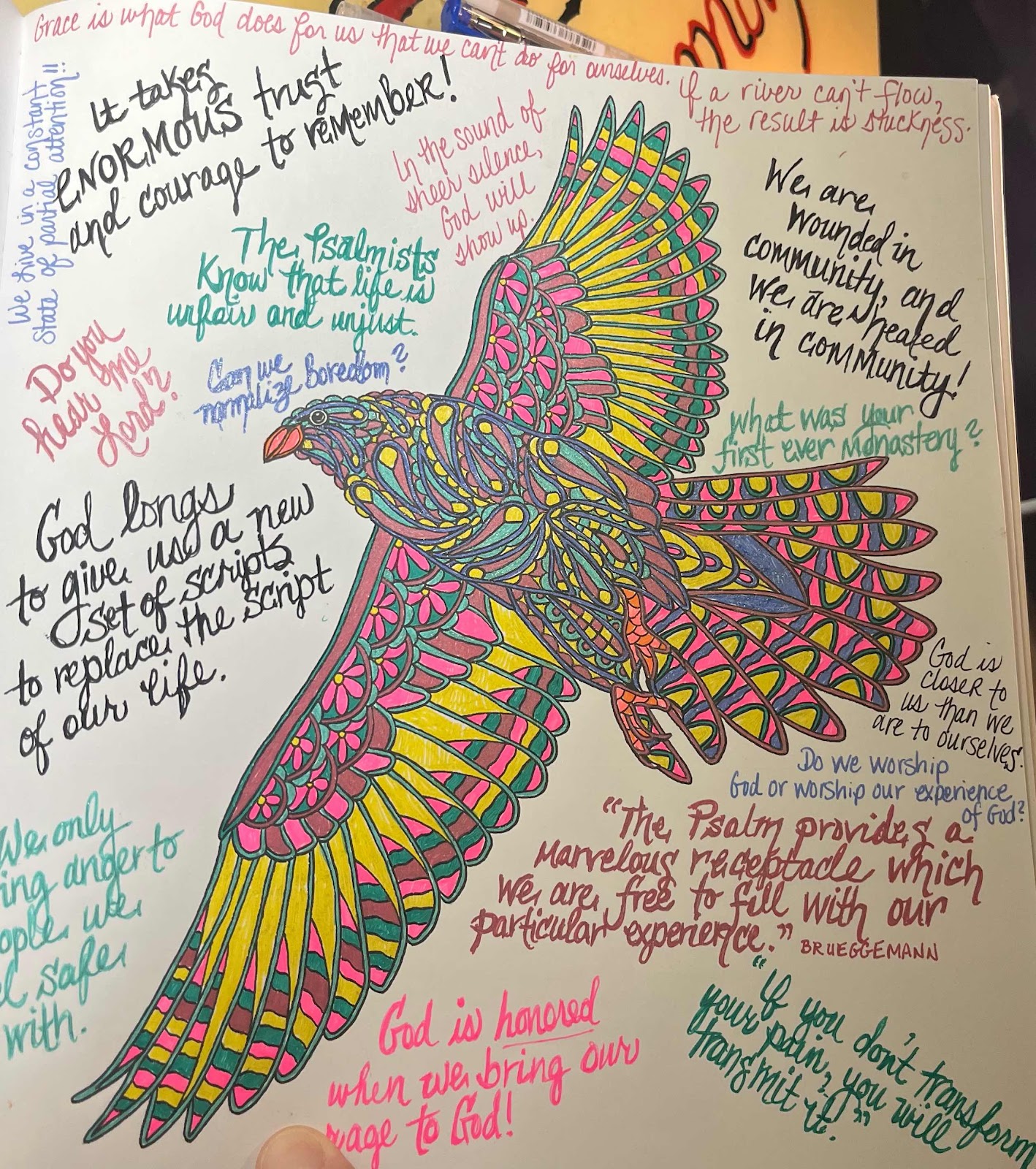
APRIL 12X12 #2: "Trauma and Spiritual Formation "


This is part 2 of a Saturday-long Conference I attended with Adam Young and a guest speaker: RICH VILLODAS for the month of APRIL. The Conference was entitled "How to Engage God About Your Story." Session 2 was entitled: "The Psalms". This talk was by Adam Young.

I accidentally deleted my notes from this section. I am so frustrated. I may go back and do them. Ugh!

My notes


Those people who know me, know I love coloring. I've been starting to take my conference notes in this fashion. It is super fun! I also relisten to the conference again and take additional notes so this is just a simple way to be paying attention on our Saturday-long events.


Tuesday, April 08, 2025

APRIL 12X12 #1: "Introduction: What If You Explored Your Story with God?"

This is part 1 of a Saturday-long Conference I attended with Adam Young and a guest speaker: RICH VILLODAS for the month of APRIL. The Conference was entitled "How to Engage God About Your Story." Session 1 was entitled: "What If You Explored Your Story with God?" This talk was by Adam Young. 

At the core of your heart is the story of how you have interacted with God about your desires and your disappointments. You may not be fond of certain portions of your life story. Surely, there are parts of your story, perhaps entire seasons of your life, which you are just not fond of. Why did God let THAT happen? How could God have watched my father treat me like that? How could God have stood by why the church hurt me so deeply? If you take your heart and story and wounds seriously then sooner or later, you will find yourself disoriented by the heartaches and betrays that have happened to you. And the very fact that those stories of harm exist for you, implicates God. 

Job in the Bible is the Biblical example of someone whose life was turned upside down by tragedy and heartache. Another example is Joseph. Jeremiah. Jonah. These people have stories that are in the narrative of scripture that are stories of heartache and tragedy and betrayal. How did Job respond when his story took a massive turn for the worse. Job responded in two primary ways: 

1. Lament

2. Anger

1. LAMENT

Job's life was going along swimmingly when tragedy struck. He lost his wealth, health, and children. And Job 3:1-4 and 24-26 recounts the first words that Joseph spoke after his world shatters. 

After this Job opened his mouth and cursed the day of his birth. And Job said: "Let the day perish on which I was born and the night that said, "A man is conceived." Let that day be darkness! Why did I not die at birth? ... For my sighing comes instead of my bread, and my groaning are poured out like water. For the thing that I fear comes upon me, and what I dread befalls me." 

Perhaps the most astonishing words are found in the very first verse. Job opened his mouth. After his friends come and sit in silence with him for seven days, after the shock of the pain, as the horror of the reality of his life is sinking in, Job opens his mouth and speaks. 

Job didn't have to open his mouth. He didn't have to speak about his pain. He didn't have to engage with God. He could have just killed himself literally or just numbed himself to the pain. He could have pushed his pain into the basement of his heart and disconnected from the reality of his life. But Job chose not to deny his pain. He chose not to ignore his story as awful as it was. He put words to his emotional turmoil. He found language to express what was going on in his body. This is what it means to engage your story with God!

When your world is falling apart (in big or small ways), will you open your mouth? Will you express to God what you are truly feeling on the inside? If it feels too overwhelming to actually speak to God about your pain or pray on a particular day, what would it be like to take a notebook and write out a prayer? You don't even have to pray it. Just write it!

It is an act of holy defiance to put words to the devastation and anguish in your heart.

It is rebellion against the evil in our world that seeks to keep your pain hidden and to keep you isolated and silent. Apart from the community. What comes out of Job's mouth is a lament. Lament is a passionate expression of sorrow, sadness, grief. Lament is what comes out of you. It might be words, screams, groans, sobs. It is what comes out of you when your dreams and hopes are shattered. 

Job's lament brings him to curse the day of his birth. And then he asks the rhetorical question: "Why did I not die at birth?" Job's story is so full of pain that the only thing that brings him comfort is wishing he had never been born. 

When pain enters your life, whether big or small, what is the Christian response to that pain? In other words, what is your attitude when you are suffering? It is very common to think: 

I should ask God to increase my faith in Him during this time.

The ultimate reason I am in such pain is because I have made something more important than God and therefore I should repent. 

I should be grateful for what I still DO have. 

Job does NONE of those three things. Each of those responses can be a way to avoid engaging your story. Each can be a way to avoid being honest with God about your heartache and pain. God doesn't say any of those things. Job doesn't even repent of valuing his possessions or family more than God. He wishes he was dead. He wishes he had never been born because his sorrow and pain is overwhelming. 

Do you feel that it is ungodly that you wish you had never been born or wish that you would die? Does that feel wrong or inappropriate? The problem is that there is no shortage of Biblical heroes who wish that they were dead. Rebecca, Moses, Elijah and Jonah all do this in the Bible. If it were wrong, then why are those stories shared in the scriptures?

Are these people self-indulgent whiners who are drowning in their own self-pity? According to the Bible, it doesn't appear so. For many people, wishing you were dead because you are overwhelmed with pain, is a part of life with God. There is nothing unChristian about it. Wanting to die at times is often part of the stories of people who deeply love God.

The laments which fill the book of Job, give us permission to feel. And if you are a Christian, chances are you need permission to feel your feelings. You need permission to feel negative emotions like sadness, anger, fear. However,  if you are going to explore your story, you need permission to feel ANGER and FEAR and SADNESS. 

What is keeping you from feeling these feelings? Not only does Job give us permission to feel, he gives us permission to talk with God, candidly, honestly, authentically, about our feelings! Job gives us permission to talk freely with God about our feelings! Job invites us to pray our feelings. 

What does that mean? 

To pray your feelings is to pre-reflectively pray your feelings to God. 

This means you pour your feelings out to God before editing your words! When was the last time you just poured out your feelings to God before making them "appropriate" for expression to a holy God or before making them consistent with a theological framework? When was the last time you poured out your sorrow to God? If you are not, with some regularity, pouring out fear and anger and sadness to God, then there is a good reason that is the case. 

Nothing, neurobiologically, is more hard-wired into the human heart and body than the tendency to run to someone bigger and stronger when you are in need and when you are not well. If you have stopped running toward someone stronger than you and stopped expressing how you are feeling, your story, particularly in your family of origin, will help you understand why you have stopped going to God with those raw emotions. Your story holds the clues and the reason. 

Maybe your primary caretakers weren't responsive to you when you ran to them for help. If that is the case, why in the world would you turn to God, a heavenly parent, when you are in need?! 

What do you need today to begin or to return or to continue running back to God and pouring out your feelings? You did this automatically as a five-year-old with your parents or you would have if they were available to you. When did you stop doing this with God?

In Job 3, we meet a man in a state of disorientation. Many of us think we are living in a just-world. A fair world. A safe world. And at some point in your life, it will come crashing down. God's invitation to you in that moment is to lament. Your story takes you down a path that you don't wish to travel. What if you expressed yourself to God authentically in those moments? What if you risked? 

Lament consists of:

1. Allowing yourself for feel your sorrow and grief and sadness. 

2. Expressing that sorrow and grief and sadness. 

If you have risked pouring out your sorrow and grief to God, you may have felt this nagging question along with the practice of lament. What is the point? What is the goal? Doesn't lament just lead to more despair? If you are not wrestling with God about your story, it may be that you lack confidence that any good will come of the wrestle? 

The path of lament need not lead to despair. Despair results when we lament without hope. Genesis 12 God says to Abram to leave his land and that he will become a great nation. However, in Genesis 11 we read that Sarah was barren. 

You can't become a great nation without a child! The story of Israel, right at the beginning, begins with utter and complete hopelessness. Sarah is barren. 

"Barrenness is the way of human history. It is an effective metaphor for hopelessness. [But] the marvel of Biblical faith is that barrenness is the arena of God's life-giving action ... After Sarah, Rebecca, Rachel, and Hannah were barren." Walter Brueggemann

It even says Israel is barren is Isaiah 54. Wouldn't we expect God to give Sarah what she longs for immediately? But because the Bible is so relentlessly true to real life, Chapters 12-14 in Genesis come and go, and Sarah is still not pregnant. The promise of God delays. Delay is hard for our hearts. Especially if you have a history of trauma. For Abraham and Sarah, they enter a season of doubt. 

"It is part of the destiny of our common faith that those who believe the promise and hope against barrenness nevertheless must live with the barrenness. Why and how does one continue to trust solely in the promise when the evidence against the promise is all around? ... Can the closed womb of the present be broken open to give birth to a new future? ... The utter impossibility of the promise becomes evident. Abraham knows what is possible. He lives in restless torment." Brueggemann

And can you not relate to that? You may be at a point in your story that the closed womb of the present may be all you can see. It's all you have lived. Maybe for years. What would it feel like to let this be truth?

Can the closed womb of the present be broken open to give birth to a new future? 

Can you risk letting yourself hope for a moment? Your body will naturally begin to engage God about the heartache of your present story or something that happened in the past. You will find, in time, SomeONE (Jesus!) in the fire with you -- in the heat of the circumstances of your life. And more than wanting a particular circumstance to change, more than that, we want to feel the presence of God in the fire with us. We want to know at an experiential, embodied level that we are not alone. God is in it with us! That's what we want to feel.

It is not pain that we fear. It is aloneness and meaningless in the pain.  

Lamenting alone, by yourself, is what leads to despair.  

Lament poured out to God can lead to something else. Eventually it leads to some version of connection with God and some meaning in the pain -- which of course, in no way makes your pain worth it. Your tears are a form of confession. They are the ultimate acknowledgement of what has been true in your life. They are the break-thru of the sometimes very long denial of reality: that your life is worth of lament. That it is worthy of tears. There are tragedies and betrayals and sufferings and heartaches that you are enduring that merit tears. Or even dry grief! (You don't have to cry! :)You know the sensation in your body when you give yourself over to sorrow and grief and sadness. 

Have you stuffed your real feelings because you don't believe those feelings are consistent with a life of faith -- with the feelings of a real Christian? You may not even know why you are sad but you think, I must Rejoice in the Lord Always. Most of us are deeply uncomfortable with our big feelings. But feelings are a window to the passionate desires of your heart. Your feelings tell me something about who you are and what you want in life. Your feelings expose the rumblings of the deepest parts of your soul. 

Neuroscience has demonstrated that you are powerless to control your feelings. Feelings happen in a fraction of a second. (And that's not a metaphorical phrase.) They occur in less than a second, before the executive control center of your brain (the part that makes choices) even comes on line. God knows this. As the creator of both your limbic system and your prefrontal cortex, He knows that you cannot control the initial twinge of sadness or the spike of anger. These reactions are automatic and unconsicous. God does not call you to get rid of your sorrow, as if you could do that in the first place. He doesn't call you to eliminate your fear or anger. He calls you to honesty about your sadness or anger or fear. We all have them. 

To deny sorrow is a rather odd inclination to those that value the Bible. There are massive chunks of text in your Bible where people are pouring out their sorrow to God. "My soul is in anguish. How long, how long? Why do you hide yourself in times of trouble. How long O Lord? Will you forget me forever? My eyes fail looking for your promise, and I say, 'When will you comfort me?"

We people with trauma need comfort. Why would God have put these in the scripture? Perhaps God wants YOU to give yourself permission to feel these kind of feelings. Perhaps God is inviting you to pour out those feelings to Him in the speech that is called lament. What if you brought your lament to God? What might happen? What might transpire in the few seconds and minutes or days following your heart-felt, tear-filled speech to God.

Lament can be difficult. When you risk connecting to your sorrow and you risk putting words to it, you will begin to feel even more of the sadness in your heart. You have neurons. Our present experiences are always linked to our past experiences. Our stories are linked. That is how neurons worked. So when you take the risk as a 48-year-old woman to feel sorrow, it will likely connect you to sorrow from your teens and 20's and 30's. That is how God helps you integrate your brain. 

2. ANGER

Okay so that is lament. Let's transition to Anger. You may not feel anger at God. You may not have memories of feeling anger at God. Perhaps your Christian culture told you it was wrong to be mad at God. As a result, if you find yourself feeling even a little bit of disappointment or anger at God, you immediately nip that feeling in the bud. If you risk talking candidly with God about your story, there will be times that you may feel abandoned by God or disappointed by God. Maybe there is a moment in your story that you feel like God did not come through for you. How could you have let me be sexually abused dear God? Why didn't you prevent it? Why did you let me move into that neighborhood? Would that have been so hard God? Or you might feel abandoned by God in the present as you try to heal from your wounds and your efforts aren't working or aren't working fast enough. 

If you are emotionally honest, sooner or later, you will also feel some anger at God. What does your anger at God tell you about YOU? More often than not, your anger of God is a result of how important God is to you. It is evidence of your holiness and faithfulness to him. Your anger God says "God matters to me!"

Let's return to Job's story. He begins to fill anger at the one who could have prevented the tragedy. Check this out from Job 9-10:

This is just a short tour of rage. Directed, unapologetically at the one who could have prevented all of it. What is Job so angry about? Job is angry that God is not responsive to his plea for help. Job is angry about God's unresponsiveness. I can say 1,000 complaints to you God, and you won't respond to a single one of them. I bring complaints, and I hear nothing back. And it is the deafening silence that is so infuriating. In the unlikely event that God actually answers me, He won't address the cause of my upset. And this is the crux of Job's pain. He wants God to respond to Him. Who of us cannot relate to that longing? 

But this isn't just in these chapters. It goes on and on after chapters 9-10. However, just because people express anger at God doesn't mean it is right to do it, does it? Well, at the end of the book of Job, God speaks. He talks about the rightness of God's words. Look at what God says in response:
 

God says, twice, that Job spoke rightly of Him. It means that it was right for Job to express his anger at God. It was right for Job to bring his truest heart in speech before God. It was right for him to speak unedited before his God. He could have said, "God isn't going to listen to me, so I am not going to waste my time yelling at Him?" In the very moments when I most need God, we can often feel like he is the least responsive. 

Is God unaware of our deep anger until we speak it aloud? Of course not. He knows it is in there! God can handle your anger. He is neither surprised by it nor afraid of it. When you feel like God has let you down, will you allow yourself to feel your anger. It isn't just Job who expresses his anger to God. The Psalmists do it. The author of Lamentations does it. 

Do you think the Psalmists are quietly speaking their anger? These people are yelling at God! God has put these expressions of anger at God into the scripture. Yes, some of these people in the Bible end up also expressing trust in God. But, how much time do you think passes between 13:1 and 13:5 where God moves from anger to trust? We think that David or the Psalmists sat down and wrote these in one sitting. Rarely are these things authored in one sitting. What if the place David found himself in Psalm 13:1 for years "How long O Lord would you forget me forever" before David was able to say "But I trust in your unfailing love?"

Anger is a very difficult emotion for many people -- especially people with a history of trauma. If most of the anger you witnessed as a child was dangerous, you may feel very reluctant to feel the anger inside. Many people say "I'm scared of what I would do if I felt my anger." Others say "Whenever I feel my anger, I end up hurting the people around me." But the dilemma is, you can't quarantine your anger. If you have it (and we all do), it is leaking out in ways you aren't aware of unless you know how to metabolize it and handle it appropriately and express it to God and others well. The best way to make sure that your anger doesn't harm those you love is to welcome it, to get to know it, and to learn how to express it well. 

Acknowledging your anger will introduce you to deeper layers of your heart. It will introduce you to yourself.

C.S. Lewis wrote a book called Till We Have Faces. The main character feels wronged by the Gods. She expresses it to the Gods. And then she goes through it a second time. And then she says this: 

Lewis is getting at something very important. The idea was that a human being must become real before it can expect to receive any message from God. You must express your actual desires. 

Do you know what you are really angry with God about deep down? What is the speech that is lain at the center of your soul for years? What is your real complaint against God? Maybe one of the reasons you are reluctant to look at the heartache in your story is because you are afraid of what it is going to do in your relationship with God. How can God meet you face-to-face until you have a face? Until you are speaking genuinely about your heartaches and sufferings? How can God respond to the deepest cry of your soul until you have become clear about what that cry is in your story? Where are the moments in your story that there was a cry? How did that cry come to be? 

Post-Lecture Notes:

"I want everyone on this call to begin to develop some compassion for yourself about why your relationship with God looks and feels the way it does. Why has your relationship been fraught or difficult? All of us have a filter (mainly our neurons). If that filter has been influenced by trauma or harm, especially from primary care takers, then it is going to be difficult for you to experientially feel the safety and benevolence of God. We all have a filter through which we experience God. I want those of you listening to this to increase your compassion for why it may be hard for you to relate to God. A feeling of Ohhhh, that makes sense. I can see that that is difficult for me because of my story." 

Much of the tradition in the church is for explanation for the things that God has done. The church doesn't focus on lamentation.