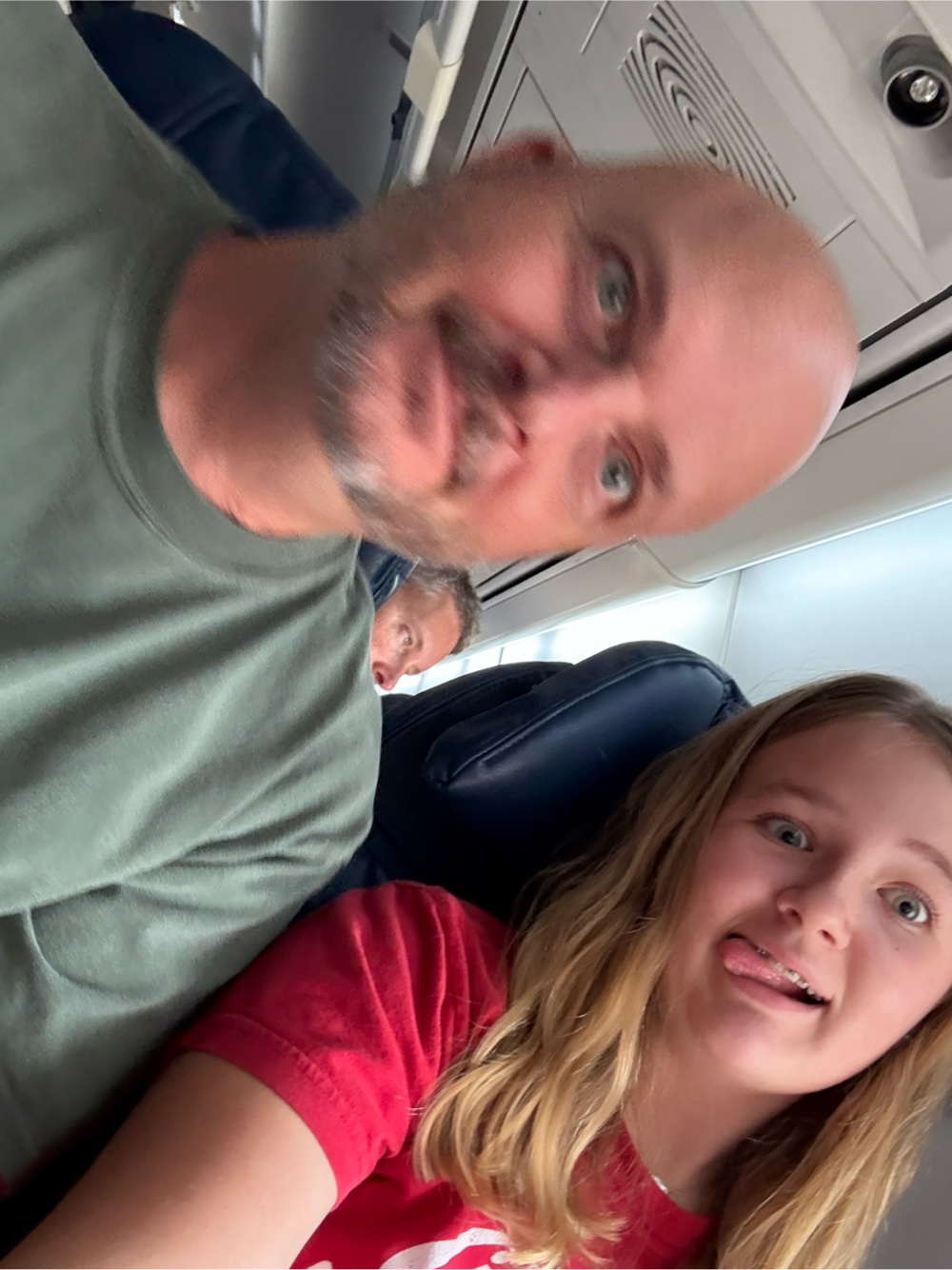
First up, our travel day from Knoxville to Atlanta and from Atlanta to London!






 Isaac went to see his friend Eliza perform in a play in Morristown! Theatre people really stick together.

It's official! Our lamb is in the store. (This is a farm store of some friends of our's across town.) They are including our lamb!


It is IMPERATIVE that we have a team helping us when we are in the vortex (i.e. "the pit" or depression or anxiety or any other grief-filled event in our life.)

I personally think everyone needs at least THREE people. They need to rotate because they have lives and they get tired. But it is crucial that we have this!
Do you have a team? If you don't: FIND ONE!
Found a few other pictures from our little Pomegranate's 12th birthday. Grama K (almost) always makes an ice cream cake for the kids' birthdays because Isaac can participate in the eating.


For Hannah's 12th birthday, John planned a special birthday treat. They went to Abingdon, Virginia (a favorite of our's) and saw a play at the Barter Theater. This was followed by dinner at the Tavern!


I love seeing each of my kids do what THEY do. Abigail is photography. Hannah is cooking/sewing. Isaac is music, of course. And Sidge is his love for the farm and outdoors.
A beautiful day with some beautiful pics.


About four years ago, one of John's five siblings moved to our neck of the woods here in Bulls Gap. They bought a little property which is actually attached to our farm at the top of the ridge. It's quite a hike, and as of yet, only Sidge has attempted it.
We don't see them as often as we would like, but we are trying to connect more often. Here were a couple of sweet pics I snagged this morning when big brother came for a visit.


This past Monday was our first day of "all the kids" there co-op. Holy cow is it nutso after four weeks of just older kids' classes. Meredith is President. I'm vice-President. We made it through.
(I type this as I go so please excuse my mistakes.)
I am attending Adam Young's monthly Saturday conference. This month the topic is "The Role of Grief and Sorrow in Healing From Trauma." The second session is with J.S. Park.
Session #2: Unraveling Myths About Grief
MYTH #1: Grief looks somber, solemn, single tear, controlled.
MYTH #1.5: You can only grieve certain kinds of loss (like death).
MYTH #2: Grief is letting go, moving on, from negative to positive.
J.S. Park is a chaplain, and he is sharing how he helps with grief. He says that whatever he says IS the grief. It may be screaming and crying or laugh or shut-down. It is ALL grief. You will need to allow your body to go through whatever your body goes through.
And while this is happening, life keeps going. Someone may come in the room where grief is being dealt with and tell you that you have to move your car because you are double-parked.
EMERGENT GRIEF: The moment the grief happens. Your body will do whatever it voluntarily wants to do in this grief.
INTENTIONAL GRIEF / CONSCIOUS GRIEF: This is more intentional and purposeful grief with cultural elements. Woven with tradition practices.
Many of us have COMPARATIVE SUFFERING "I haven't had it as bad so I shouldn't be grieving."
All change involves loss and all loss involves grief.
A break-up can lead to pain as much as a death. Losing a job can cause very difficult pain as well. You can lose a dream, faith, or world-view.
What are some non-death losses that you have experienced? We have permission to grieve these things.
Grief is NOT linear. Grief isn't about eventually letting go. "It's okay that you are not okay."
Grief is not moving on. It is moving with. It is letting in.
****
A passage from Toni Morrison's book Home.
The protagonist Cee realizes she can no longer have children.
“Come on, girl. Don’t cry,” whispered Frank.
“Why not? I can be miserable if I want to. You don’t need to try and make it go away. It
shouldn’t go away. It’s just as sad as it ought to be and I’m not going to hide from what’s
true just because it hurts.” —Toni Morrison, Home (p. 178)
*****
The grief will always be with us but the color will change.
Why are we so indoctrinated in the thought that we need to "Let go of grief."
Our society does not give us bereavement time. There are often 3-4 days provided for grief. Grief is often considered negative and bad because it stops us from being productive.
Grief is shrunken into a forced timeline because:
1) it was considered the one emotion that could lead the oppressed to revolt in anger at injustice,
2) it was considered an inconvenience to the oppressor, and
3) grief is a remembrance of what was lost, it is in itself a memory that we carry.
We are going to carry those who have died. We can carry them in our memories, the way they loved us, all the difficult and hard things. We can make room for that inside of us.
What are some of the phrases and ideas we have been taught about grief? Things that didn't help. Maybe in the midst of grief you can say to someone, "What was your dream? What dream died?"
(I type this as I go so please excuse my mistakes.)
I am attending Adam Young's monthly Saturday conference. This month the topic is "The Role of Grief and Sorrow in Healing From Trauma." The first session is:
Session #1: What Grief Is and How to Respond to it in a Way that Brings Healing
Our world is one where grief and sorrow are unwelcome. Most of us do not feel that the people around us can bear the depth of our sorrow and grief. We do not feel welcome or that people around us are willing to be in it with us. As a result, we take our sorrows and sadness and try to push them out of awareness. In this way, we are declaring to our sorrow You are not welcome in my life.
Because belonging is so important to us, we can't risk it by sharing our grief with others. We are afraid that if we bring our sorrow to our friends and loved ones, those sorrows would cause relational distance between us.
Francis Weller: The Wild Edge of Sorrow is a book he's recommending and going to talk about a lot. We keep our sadness hidden so we are not "kicked out" of our groups. Sorrow or grief is defined as: "feeling of distress, pain, caused by losing something or by disappointment." If you lose your spouse, a job, the ability to do an activity that you love ... any of these things can cause grief and sorrow.
Let's look at the word DISAPPOINTMENT. You will feel sorrow when you are disappointed. You don't only feel sorrow when you lose something. Disappointment can be one of the most painful feelings to tolerate. Disappointment causes us to feel the painful ache of sorrow.
Dis -- appointment is a broken appointment. Do you let yourself feel sorrow about your disappointment? Most people will feel anger when they didn't get to do something with their spouse that they wanted to but they won't feel sorrow or disappointment. Your body's natural response is to hurt and ache and feel sorrow and grief. You cannot be an alive person without experiencing losses and disappointments in this world frequently.
If you allow yourself to WANT, you will feel DISAPPOINTMENT often.
Weller identifies several types of grief:
1. The loss of someone or something we love. This is the type of sorrow that most people are familiar with and this is the only type of sorrow that most of us are allowed to feel in this world. However, there are many other types of sorrow and grief.
2. Maybe you need to feel loved in a particular moment and you were not. That is grief too! That is a loss. That is a type of grief, an ache, a sorrow. We carry grief in our bodies about those moments that we needed to be loved and we weren't. There are moments in your life in which you needed to be seen, soothed, cared for, and you weren't. That is a profound loss that needs to be grieved.
3. Sorrow of not being welcome. This means the sorrow of not belonging anywhere. Not being able to find a community that welcomes you in the fullness of who you are.
“When we are born, we are designed to anticipate a certain quality of welcome
and engagement. In short, we expect what our ancestors experienced as their
birthright, namely, the container of the village.”
God made you to be welcomed into a village. People who say "you belong here." You need people who are wiser than you, stronger than you, and deeply committed to your freedom and flourishing. This is what the elders of the village are supposed to be. And most American culture is lacking elders. The lack of the village is a deep source of our sorrow. At the core of our grief is our longing to belong. We are not sure how we will be received if we feel our feelings in public or with another.
Many of us have a vague sense that we are lacking something ... something is missing in our lives. “We are waiting for the village to appear so we can fully acknowledge our sorrows. At the
core of this grief is our longing to belong.”
The sorrow of not being welcomed. The sorrow of not belonging anywhere. Not having a
community that welcomes you and says “you belong here.”
“When we are born, we are designed to anticipate a certain quality of welcome
and engagement. In short, we expect what our ancestors experienced as their
birthright, namely, the container of the village.” Francis Weller
You were not designed for the individualism that plagues modern American culture.
You were designed to need the container of the village.
“We are waiting for the village to appear so we can fully acknowledge our sorrows. At the
core of this grief is our longing to belong.” Francis Weller
“Our profound feelings of lacking something are not a reflection of a personal failure, but
the reflection of a society that has failed to offer us what we were designed to expect."
GRIEF is not a problem to be solved. If you feel sorrow, it doesn't mean there is something wrong with you. It means that you are paying attention because the world is filled with injustice, heartbreaks, losses. Modern American culture is devoted to
DENIAL
and
NUMBING!
Many of us are focused on GOING UP. Always. We want everything to be improving and getting better: THE ASCENT! This is so American that we don't even question this. When you are only looking at going up, it is difficult to look at emotions that cause you to DESCEND. Sorrow and grief will take you down. And since our culture is so focused on ascending, this feeling is very scary to us. And so, we DENY and we NUMB.
Connection only occurs when someone is vulnerable. When we let people into our hearts, connection occurs. The cost to always ascending is ISOLATION and LONELINESS.
Time does NOT heal all things. Those things will remain in the basement of your heart, waiting to be taken seriously and for care and support. Most of us do not welcome our sorrow and grief since we fear that others won't welcome or make a place for our sorrow and grief, you push them down and make them unwelcome.
Sorrow and grief will FLOW and new things will emerge if you sit with the sorrow and grief.
What are the conditions needed to allow our sorrow and grief to heal?
# 1 We need to own that our sorrows and griefs matter and should be taken
seriously. Grief knows where to take us. It will take us where we need to go if we let it.
# 2 We need to gradually move from a posture of contempt toward our sorrow and grief to a posture of compassion and kindness and welcome. Be kind to yourself. I should be past this by now. I shouldn't feel this way anymore. If you feel this way, you have some measure of self-contempt for your wounds. When you are ashamed that you are still hurt about something from you past, you won't risk sharing it. You feel shame.
# 3 We need to find a few people who can be the village for us… this will allow us
to risk sharing our sorrow and grief with other people. You need a few people like this in your life. For many of us, our greatest sorrow was that we were left behind in our pain. It wasn't the loss of your dream. It was that we were alone in the wake of that betrayal or hard thing. Our body is designed to heal. However, when something bad happens to you, you need the attunement of other people in your community to heal from that wound. We are not designed to heal by ourselves. You need withness and comfort from other people pulses. Do you believe your sorrow is worth of care from others? If you have pain from your past (developmental trauma), it is almost for sure there is trauma stuck in your body that will need to come out. This is because you didn't feel safe to get that trauma out when you were growing up.
YOU HAVE TO FEEL IT, TO HEAL IT NOT FAKE IT TO MAKE IT!
# 4 We need to move our bodies in a way that allows for the integration and
release of our sorrow and grief. In other words, rituals. We need rituals to work
through our sorrow and grief. A ritual is a sequence of bodily movements and symbolic actions performed with emotion and intention for the purpose of healing and transformation. A funeral. An event that allows people to wail and get grief out. These are symbolic gestures. You have to be emotionally connected to do these. You can't just go through the motions. Many of us still feel a need to be held. That is not an abnormality. That doesn't mean something is wrong with you. It means your body has a very valid need. Sometimes we need to be held. Rituals are necessary to provide: (1) containment and (2) release. The witnesses create a container for the sorrowful person to feel their pain all the way down. They provide our bodies with the opportunity to express things that are deeper than words.
There are things in our bodies that are too deep for words. The sorrows go down so deep -- even before we had words. We may need to release and engage these emotions bodily.
God made human beings to heal through rituals with others.
“I learned that sadness does not sink a person; it is the energy a person spends trying to avoid sadness that does that. When I stopped trying to block my sadness and let it move me instead, it led me to a bridge with people on the other side.” Barbara Brown Taylor
September 4th was Hannah's "real birthday." She is now 12. She really wanted a unicycle as she has learned to do this at the Kotynski's. (Uncle Eddie is a big unicyclying guy). So that was her main big present. Each of the kids actually got her something this year (on their own!) The picture with the stuffed animals was something Isaac got her.
We opened family presents on Thursday evening. And then today (Friday), Katie and Eddie and their kiddos came over with the grandparents for some of Grama's famous ice cream cake.


 |
| Hannah got a new jacket from her Grama Joni for her birthday |
 |
| The picture looks a little weird, but Hannah was taking a selfie of her pants. She made them! |
 |
| The General Morgan has some photos from Kristin G. And our Hannah is in there! |
Abigail had the opportunity to go to Lily's 15th birthday. Here are a few photos from their fun time:


How to Engage Someone Who Has Harmed You
INTRODUCTION
You must "judge" to see that the person who has hurt you, DOES have a speck. The whole pint of this teaching that begins with "Do not judge" is that Jesus calls you to judge other people -- and to judge them well.
He is more interested in being provocative than being clear.
When Jesus says, "do not judge or you too will be judged," he is using the word judge to a posture of condemning the other person ... and condemning another person is very different from naming their or identifying their speck.
You need to judge accurately:
1. Normal Garden-variety sinners
2. Wicked people
3. Evil people
You must first come to see: What kind of person am I dealing with? You will be called to engage each of these categories of people differently.
WICKED PEOPLE need to be shamed. Luke 13 "You hypocrites! Doesn't each of you on the Sabbath untie your ox or donkey from the stall and lead it out to give it water? Then should not this woman, a daughter of Abraham, whom Satan has kept bound for eighteen long years, be set free on the Sabbath day from what bound her?"
And then in Luke 13:17, "When Jesus said this, all of his opponents were humiliated." (Very similar to shame.)
Why does Jesus treat people differently? This is not how he treated the woman at the well (who has done a lot of bad things.) Why is he kind and welcoming to her and shaming to these religious leaders in Luke 13?
He engages with a person based on the condition of that person's heart. Jesus knows if the person is wicked or just a garden-variety-sinner.
Your calling is to be shrewd as a snake or wise as a serpent and innocent as a dove. Matthew 10:16
Most of you know that you are supposed to be as innocent as a dove? But are you aware that you are supposed to be as shrewd (showing sharp powers of judgment) as a snake or as wise as a serpent.
What happens if you engage a wicked person the same way you talk to a normal sinner? At best, you are going to feel like you keep running into a wall. Your words will bounce off a wall and nothing changes.
"Do not throw your pearls to pigs. If you do, they may trample them under their feet and turn and tear you to pieces." Matthew 7.
Some of you are being torn to pieces by people in your life who do not mean you well. People are taking the pearl you offer and tearing you to pieces. You say, "Ouch, that hurt." And the person just tears you to pieces. They don't deserve your pearls.
So you must identify: what kind of person are you dealing with? The woman at the well? Or a hypocrite religious leader? How are you supposed to know?
Remember: You can never judge another person with finality. There is no person whose heart is beyond redemption.
The purpose of today is NOT so you can go out into the world, start pointing at people and saying, "She's wicked, he's a normal sinner, and that person over there is evil." You want to know who you dealing with or you will hit your head against a wall over and over and over again.
HOW DO WE IDENTIFY WICKED PEOPLE?
You may do wicked things but not be a wicked man. Have you repented? And do you have a pattern of scapegoating people? There has to be a persistent pattern of wickedness before you say to yourself, "Okay, my dad is wicked."
In Jeremiah 8:6 God judges Israel by saying, "No one repents of his wickedness, saying 'What have I done?'"
The essence of wickedness is the refusal to look honestly at your own words and actions and say, "What have I done?"
Wicked people refuse to suffer the guilt feeling of guilt.
Wicked people flee the light of self-exposure and the voice of their own consciousness. Wicked people will not bear the voice of their own conscience. They have hardened their hearts and consciences. They have silenced it.
Wickedness is not about the magnitude of the harm you do. It is the refusal to acknowledge the harm.
If they can feel the harm that they have done and can acknowledge it they are not wicked. They must also actually FEEL that harm.
"The central defense of wicked people is not their sin but the refusal to acknowledge it. Wicked people are characterized by their absolute refusal to tolerate the sense of their own sinfulness. " Scott Peck, PEOPLE OF THE LIE.
You may be the best community member ever and ONLY harm your three children. If they are not repenting, they are more than a garden-variety sinner. They have hardened their conscience and can't feel what they have done.
They won't claim to be without sin. They aren't stupid. They will often admit (especially if they are a Christian) to being a sinner. But they won't be able to tolerate a sense of their own sinfulness on their heart. "Oh my gosh, what have I done to my three daughters. What have I done?" They won't feel genuine sorrow and remorse.
Since wicked people can't bear to have their sin brought into the light, they are impervious to feedback that doesn't feel good. Your words of hurt do not land. Your "ouch" does not affect them.
If you say to a wicked woman, "I was hurt when did X," she will not feel compassion for your hurt. She will not feel sorrow that you are hurt. They will deny intentionality. They will say, "I didn't mean to hurt you."
Wicked people are unwilling to compassionately empathize with the pain of anyone who says, "Ouch, you hurt me!"
Psalm 17, "They close up their callous hearts, and their mouths speak with arrogance." The wicked have made a thousand choices over many years to slowly but surely harden their hearts. And so their heart is calloused.
YOU WILL NEVER FEEL THAT THEY ARE HURT THAT THEY HURT YOU! THEY CAN SAY, "I AM SORRY," but the words are empty.
1. SCAPEGOATING
Scapegoating is about projecting your own sin and failure onto another person and then punishing that other person for it. The goal of all scapegoating is to separate the scapegoated person from the family, from the church, from the business, from the community ...
They will accuse you of the very things they do themselves. It isn't random. So a son says to his father, "Dad, growing up, you ever wanted to be with me or spend time with me." The son is saying, "OUCH!" And their father, "I'm sorry you feel that way, but it felt like you never wanted to be with us. You always kept your mother and I at arms-length." That is scapegoating.
When you accuse a wicked person, a wicked person will accuse you back. A wicked person does not listen to rebuke.
A daughter says to her mom, "You leaned on me too much when I was a kid." And then the mother says, "Well you wanted the burden. You told me you wanted us to be close and wanted to discuss things."
Another example. Daughter says, "Can we talk about some of the ways that you hurt me when I was growing up." She is just asking for a conversation. The mom says, "Oh sure, what horrible thing did I do know?"
Scapegoating is the beginning of being cast out of a family.
Psalm 38:20 "Those who render me evil for good accuse me because I follow after good."
"Prophets and priests alike, all practice deceit. They dress the wound of my people as though it were not serious. 'Peace, Peace,' they say, when there is no peace. Are they ashamed of their loathsome conduct? No, they have no shame at all." Jeremiah 6.
Dan Allender say, "We all fear to some degree being cast out of another garden -- be it a tightly knit family or an authoritarian church -- yet to defy a wicked person results in sure banishment." It's a huge fear of us as humans to be cast out. And if we defy a wicked person, they will begin the process of banishing you from the family.
2. INTELLECTUAL DEVIOUSNESS
This is the second characteristic of wicked people. "His speech is smooth as butter, yet war is in his heart; his words are more soothing than oil, yet they are drawn swords." Psalm 55:21
The Bible is full of language about being spun around by the words of wicked people. Psalm 64: 3 says: "They sharpen their tongues like swords and aim their words like deadly arrows."
Psalms 109:2 says, "Wicked and deceitful men have opened their mouths against me; they have spoken against me with lying tongues."
Are you beginning to get a feel in your body for what it is like to talk to a wicked person about how they have hurt you? You may enter the conversation feeling clear in your heart about what you want to say. But as the convo unfolds, you start to feel confused. You will often feel confused during and after the conversation.
"Wicked people routinely portray their motives and behavior as innocent. They are never the perpetrator of harm, but always the victim of it. They are very gifted in making the victim of their abuse feel like the perpetrator of it. If you expose the darkness of their behavior, you will be accused of being troubled, unreasonable, too sensitive or even cruel: 'How could you think that about me?'
A wicked man will portray himself as the real victim -- you simply misunderstand his intentions and then falsely accuse him. Because wicked people see themselves as the real victims, they feel justified in making you pay for what you have done to them." -- Allender and Longman
The result of the spinning and shifting, you'll often come away wondering if you are the one with the problem. A lot of self-doubt. The wicked are brilliant from diverting attention away from the issue you raised and highlighting the problem with you.
3. WEAPONINIZING FRAGILITY
They use their tears as a weapon to keep you from speaking. #1 and #2 are when people use power against you. This one is power that operates under a disguise of powerlessness or weakness.
Are they pretending to be not smart or not strong enough? Weaponizing her fragility is a very powerful and sophisticated move. You think of her as weak, but she is actually far more powerful than you realize. Just the possibility of her tears keeps you, a grown man or woman, keeps you from speaking a sentence to her. And you aren't a timid person. You'll risk saying hard things to others -- but not your mom.
This isn't true of all wicked people. But it is common. Wicked people are essentially cowards. Wicked people despise the cost of growth. The cost of growth is repentance. You have to own your sins and failures and take ownership of them.
Hopefully, you see, it is not always easy to spot a wicked person. The temptation is to think, "If I saw a wicked person I'd know it."
"The wicked are most ordinary. They live down the street. They may be rich or poor educated or uneducated. There is little that is dramatic about them. They are not designated criminals. More often than not they will be 'solid citizens' -- Sunday school teachers, policeman, or bankers, and active in the PTA." -- Scott Peck, People of the Lie
Wicked people do not stand out as bad people. They can be incredibly kind and compassionate. They can be up front on stage at church and sing worship songs with uplifted hands. In fact, it is likely that a wicked person will treat you with kindness and compassion as long as you don't threaten their self-image by confronting them about something.
2 Corinthians 11: "Such people are false apostles, deceitful workers, masquerading as apostles of Christ. And no wonder, for Satan himself masquerades as an angel of light. It is not surprising, then, if his servants also masquerade as servants of righteousness."
EVIL PEOPLE
Evil people add a commitment to destroy you and humiliate you. Wicked people won't seek to destroy you as long as you play the game the way they ask. Evil people also want to humiliate you and eventually destroy you. They will use mockery geared to your humiliation. You will know the feeling in your body of being humiliated.
HOW TO LOVE PEOPLE WELL
If your relationship with, a parent for example, hasn't changed in the last five years, you haven't loved the person well. Love always, always disrupts the status quo. Love disrupts the current state of the relationship.
Honor Your Father and Mother:
#1 -- Much of what you think of as honoring your parents may not be honoring at all.
#2 -- Much of what you think of as dishonoring your parents may actually be the beginning of a heart to do them good.
Often times the desire to speak truth to your parents comes from a longing for a deeper, more honor relationship with them.
Part of you is actually wanting more goodness with your parents. More closeness. More authentic, genuine, real relationship.
Are you able to take a risk with someone and say, "Can we talk about the ways you harmed me growing up."
HOW DO YOU LOVE A WICKED PERSON?
Direct confrontation will not work with a wicked person.
You can offer a pearl and see what they do with it. Telling someone else how you've experienced them and see what they do with it. Give the boss that hurt you a pearl and see what they do. If their response indicates that there is no curiosity about how he harmed you, then you are most likely dealing with a wicked man with a hardened heart.
"The key to loving a wicked person is judicious, well-planned disruption. The key is insightful preparation, clear boundaries, and courageous consequences." Dan Allender
INSIGHTFUL PREPARATION
You have to tailor your words to the kind of person you are dealing with.
"An enormously good gift to give a wicked person is to foil their effort to win, to frustrate their attempts to dominate. Wickedness can never be overthrown through rational, reasonable argumentation." Dan Allender
You can't engage with a wicked person the way you would with a regular garden-variety-sinner.
Asking questions that disrupt the status-quo.
The goal is to expose and invite.
"Sometimes what is called for is a cunning strategy in which you outmaneuver the enemy for the purpose of rendering her powerless so that you can offer her opportunity for restoration." Dan Allender
Where are you editing what you really want to say deep down. Status quo = bondage.
Some of you can't even broach the subject. Way too scary and painful to even contemplating doing it. There is something overwhelming about saying a sentence or two like that.
Those words are a pearl that you are offering her. You can see how she responds.
Your task is not to tell them what they did wrong. It is to tell them how you have experienced them and are experiencing them.
When you are committed inside to convincing another person how they have harmed you, you have become connected to them in an unhealthy way. You shouldn't NEED that the other person to acknowledge it for it to be real.
DO NOT TRY TO CONVINCE OR COMPARE. IT IS TO OFFER A PEARL.
If the wicked person continues to make comments that are inappropriate and they won't stop doing it, you may have to offer CLEAR BOUNDARIES and COURAGEOUS CONSEQUENCES. You say, "I'm sorry, you keep saying this thing about me that I have asked you not to say. If you do it again, we will have to have a consequence."
"At some point it i snot loving to continue a relationship with a person who consistently and perniciously sins against you without some sign of repentance and change." -- Dan Allender
A wicked person will not repent until they feel pain. So what is the consequence you are putting into place?
In Hosea, God turns from his people. They won't admit how they have harmed God. Their hearts have hardened and they feel shame. Severing
a relationship for a season can be a very holy and loving God-like thing to do. But he also speaks about this in the New Testament too.
"Do you think I came to bring peace on Earth? No, I tell you, but division. From now on there will be five in one family divided against each other, three against two and two against three. They will be divided ..." Luke 12

